Our intuition can provide us with important insights for assessing a situation. In order to capture this perspective, the affect balance has been developed.

Picture taken by the author
Our intuition can provide us with important insights for assessing a situation. In order to capture this perspective, the affect balance has been developed.
In our brains, two systems are at work. One is your conscious rational mind, and the other works so secretly that you rarely notice it. Psychologists and psychoanalysts call it the unconscious. Other people refer to it as gut feeling or intuition. This unconscious system has direct and immediate access to all your past experiences. Thanks to its access to this immense knowledge in a fraction of a second, it can provide you with useful advice, as I explained in my article on the two systems.
Somatic markers
Unfortunately, your unconscious does not communicate its conclusions in clear and unambiguous language. Its messages are conveyed through your body. Neuroscientist Antonio Damasio calls them “somatic markers.” You can feel them in your body, for example in the form of a smile on your lips, tense shoulders, or a knot in your stomach. These messages, as bodily sensations and emotions, are rather vague and difficult to perceive and interpret, whereas those from your rational mind are precise and clear. This is why you often don't notice them or don't know how to decipher this vague information.
The affective aspect of somatic markers
At the University of Zurich, psychologists Dr. Maja Storch and Dr. Frank Krause developed another method for accessing the conclusions of your unconscious. They take advantage of the fact that somatic markers do not only have a physical component that can be felt in the body. There is also an emotional component, which involves evaluating things according to the criteria of “pleasant” and “unpleasant.” This is more easily accessible than vague bodily sensations. To make this emotional aspect of the unconscious visible, the two psychologists created the “affect balance”.
The affect balance has several advantages:
- It allows everyone to explore their own unconscious without having to consult a specialist.
- The affect balance is an alternative to talking about emotions and is very appealing to highly rational people.
- It provides a cognitive approach to emotions, which is suitable for more intellectual people and those who find it difficult to name their feelings.
Distinguishing negative and positive emotions
In general, we imagine that positive emotions are the opposite of negative emotions. This conception of emotions can be represented by the following scale:
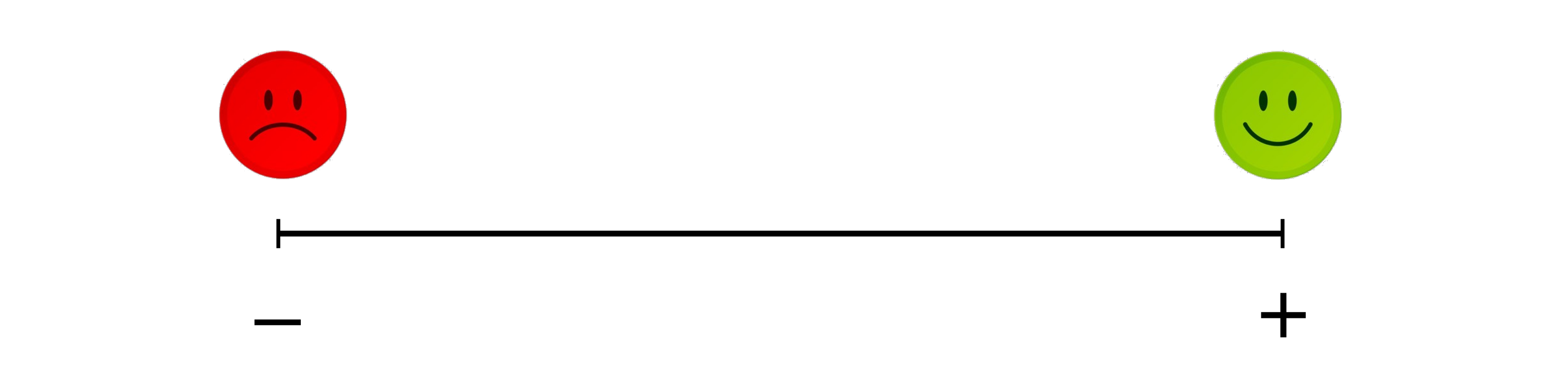
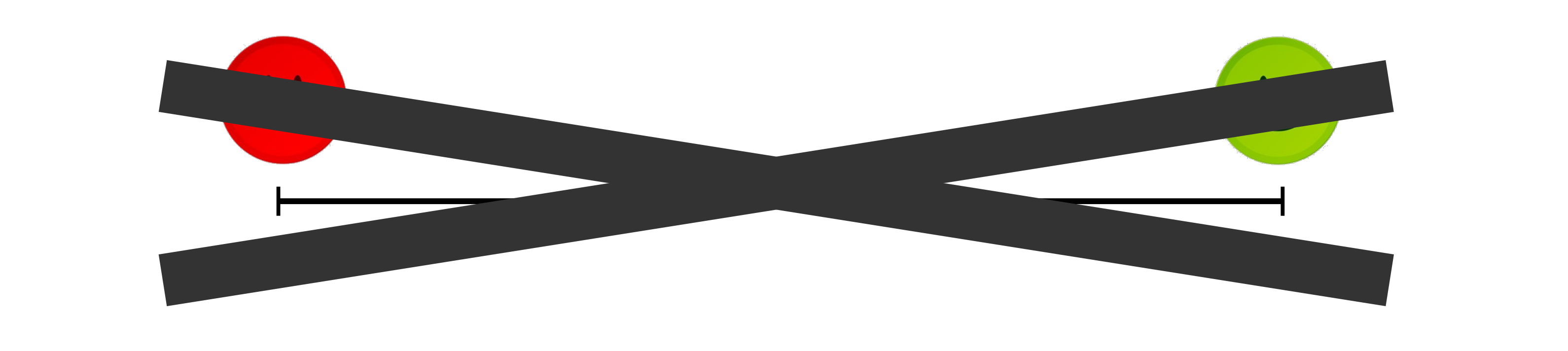
This scale is based on the assumption that we automatically feel better when we move away from a negative emotion. From your own experience, you have probably already realized that this is (unfortunately) not the case. Furthermore, this representation does not reflect how your brain works at all.
Two independent circuits
In the brain, positive emotions are generated by a circuit that is separate from the one used for negative emotions. The reward system, which among other things produces dopamine, generates positive emotions. The punishment system, which produces the stress hormone cortisol is responsible for negative emotions. In the brain, the nucleus accumbens is involved in creating positive emotions. In contrast, the amygdala plays an important role in the other circuit.
Both systems can be activated at the same time. This explains why we can have mixed feelings about a subject. Positive and negative emotions and their intensity must therefore be evaluated in parallel. For these reasons, it is necessary to use two separate scales to visualize positive and negative emotions.
Designing the affect balance
For the affect balance, draw two vertical lines next to each other. The one on the right will be for negative emotions and the other for positive emotions. At the bottom of each scale, write the number “0” (zero emotion) and at the top, write the number “100” (maximum intensity of the emotion). The affect balance looks like this.
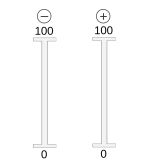
You may be surprised not to see any graduations. This is entirely intentional, as it is a visual analog scale. Why is it used? The presence of a scale, such as 50, 70, or 30, activates your rational mind. Without a scale, your rational mind does not know how to respond and leaves the assessment to your unconscious, which does not need a scale or numbers. It is important to respond spontaneously so that you do not start thinking about the “right” answer, which would spoil the result.
Without thinking, you place a mark on the left line for the intensity of the negative emotion and a mark on the right line for the intensity of the positive emotion. Then, you can see the intensity of each emotion at a glance. If you like, you can use your two index fingers and move them up or down on the two lines, as if they were two knobs on a mixing board. You stop when it feels right. If needed, you can later convert your marks into numbers between 0 and 100.
A very personal score
If you have only had positive experiences with a certain topic, the affect balance will be -0 and +100. On the other hand, if you only had negative experiences in the past, the balance will be -100 and +0. For most topics, you will have mixed feelings. There are two classic examples of mixed emotions: getting a promising job at a new company can elicit mixed emotions, as can the arrival of your first child. Furthermore, certain everyday activities normally elicit hardly any emotions, either positive or negative, such as simply washing your hands.
The result of the affect balance is purely individual, as it is based on experiences that naturally differ from one person to another. When you ask someone what foods they dislike, they may mention one of the following: liver, cauliflower, goulash, seafood, celery, tofu, bell peppers, cardamom. However, other people will give you different answers. Preferences vary from person to person, and it is often impossible to find the cause behind them. There is no point in justifying your likes and dislikes.
Discovering your affect balance
The affect balance may be a completely new concept to you. I invite you to discover it through the following steps:
- Find situations, objects, and people that only generate positive emotions (-0 and +100).
- Find situations, objects, and people that only produce negative emotions (-100 and +0) in you.
- Then do your affect balance for the following things: pizza, vacations, work, hiking, heat, riding a bike, going to the movies.
I hope this exercise has given you an idea of how the affect balance works.
An alternative to pros and cons lists
Sometimes, especially when faced with difficult decisions, people think they can find the solution by thinking things over excessively. They draw up pros and cons lists, without ever reaching a decision. The affect balance takes a completely different approach.
If you want to take an important decision, the affect balance allows you to obtain a second opinion, thereby complementing your analytical conclusions. If you come to the same result using both approaches, the two systems are in agreement and indicate the right decision to take.
When there is a discrepancy, it is usually worth digging deeper and looking for reasons that, from the unconscious point of view, could be in favor of or against a particular option. This will give you a better understanding of your inner resistance so that you can incorporate it into your thinking. Ultimately, this will help you reach a decision that is more in line with who you are.
Even for insignificant everyday decisions, an affect balance can be useful because it reduces the time needed to make a decision. If I have two options, for example, whether or not to go to the movies, instead of thinking about it too long, I often quickly do an affect balance.
The role of the affect balance in the ZRM
The affect balance plays an essential role in the self-management according to the Zurich Resource Model (ZRM) developed by Maja Storch and Frank Krause. It makes it easy to determine what you really want, as this tool allows you to explore the intentions of your unconscious. If you ignore your unconscious, you run the risk of it sabotaging your goals, even if they are thought out well.
In the ZRM, we look for resources (images, words, phrases, reminders, etc.) that support a person in their goal. When it comes to a resource, it is essential that it generates a strong dose of positive emotions, but no negative emotions. In the affect balance, the left column must therefore be zero and the right column must be at least 70. If feelings are mixed, the resource should be discarded. This is the only way to ensure that the resources will have the desired effect.
The affect balance in coaching
In coaching, the affect balance is also a powerful tool.
- When a person expresses only negative (or positive) emotions about a subject, the affect balance can be used to check whether there are other emotions that the person is not aware of.
- When a person cannot find the right words to express their feelings about a situation, the affect balance provides another way to access their emotions.
- The affect balance can help a person faced with two options to decide between one or the other (or neither).
Before doing an affect balance with someone, it is necessary to ensure that they understand the concept and can apply it. It is therefore recommended to start with a small exercise by looking for things that trigger emotions -100 | +0, and then -0 | +100.
The affect balance – a precious tool
The affect balance gives you a valuable insight into your emotions and your unconscious. When using this method, it is important that you mark your intensity on both scales as quickly as possible. Otherwise, your balance will be skewed by your rational mind and will therefore be worthless.
The affect balance does not replace the thought process involved in making a decision. But it does offer you another perspective on a situation. In my experience, this method usually helps to stop ruminating about a decision and restore a sense of calm. It also aids people who regularly struggle to make decisions, enabling them to make more satisfying decisions more easily.
I highly encourage you to try to use affect balance regularly, whether for very mundane decisions or important ones.
Main source (in German):
- STORCH, Maja, KRAUSE, Frank et WEBER, Julia, 2022. Selbstmanagement – ressourcenorientiert: Theoretische Grundlagen und Trainingsmanual für die Arbeit mit dem Zürcher Ressourcen Modell (ZRM®). 7. überarbeitete Auflage. Bern : Hogrefe. ISBN 978-3-456-86214-9.
This article was first published in French in August 2024 and has now been translated into English by the author himself.
Author of the article: Beát Edelmann, expert in neurodiversity (autism, ADHD and high IQ) and personality exploration. He is the founder of the Abundana Institute for Self-Management in Geneva, which offers coaching, training, and consulting services in French, English, and German.
